
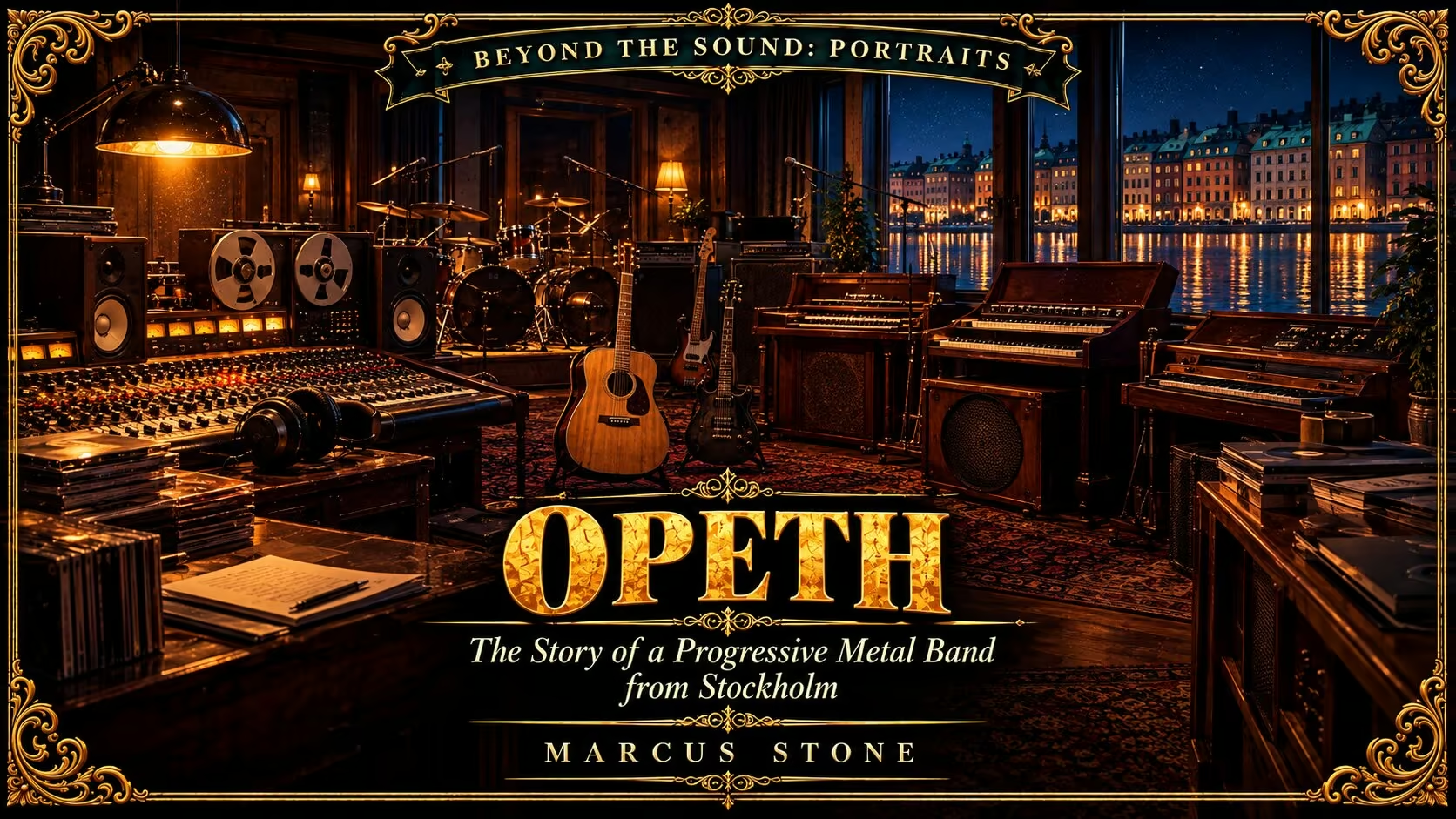
BookPortrait
Opeth: The Story of a Progressive Metal Band from Stockholm
The Opeth book: the band’s story, told record by record, from Orchid in 1995 to The Last Will and Testament in 2024.
- SeriesBeyond the Sound: Portraits
- AuthorMarcus Stone
- Release date20 November 2026
Opeth recorded Deliverance and Damnation in the same sessions of 2002 and released them five months apart, in November 2002 and April 2003. The two sleeves tell the story in their credits.
Opeth: The Story of a Progressive Metal Band from Stockholm is part of my Portraits series, one band to a book. It is a biography of the progressive metal band from Stockholm that follows Opeth record by record, from Orchid, released by Candlelight in 1995, to The Last Will and Testament in 2024. If you want an Opeth biography built on release pages, credits and charts, this is it.
The musicians are Mikael Åkerfeldt, Peter Lindgren, Johan De Farfalla and Anders Nordin on the first albums; Martin Mendez and Martin Lopez in the line-up of Still Life; and Per Wiberg, Fredrik Åkesson, Martin Axenrot, Joakim Svalberg and Waltteri Väyrynen in the years that followed. I read each record as a document: what its release pages print about tracks, timings, credits, labels and catalogue numbers; where the official chart archives place it; and what signed reviews and interviews have said about it.
What is inside the Opeth book
- Orchid, released by Candlelight in Europe in 1995, and the American edition that followed in 1997
- The rhythm section that changed between Morningrise and Still Life, and the album in between, whose sleeve credits the performance to the band as a whole
- Steven Wilson in the credits of Blackwater Park and Damnation, line by line
- The four concert releases, from Lamentations to the Royal Albert Hall and Red Rocks, read on their release pages
- Heritage, Pale Communion and the keyboards in the credits, from Per Wiberg to Joakim Svalberg
- Sorceress, and In Cauda Venenum in Swedish and in English
- The Last Will and Testament, its guests Ian Anderson and Joey Tempest, and a different name at the drums
Free with the book: a downloadable reference card. A two-sided bonus sheet, reached by a QR code at the back of the book, lists the fourteen studio albums and the four concert releases with the catalogue number and date of one edition each (two for In Cauda Venenum), and gives a table of the British, German and Finnish charts, with the name of each chart. You can also download the free reference card here.
How the book works
Every chart figure carries the name of its chart and its source: the official archives of the United Kingdom, Germany and Finland, two weekly lists from Sweden and, for America, Wikipedia, named in the sentence. Every judgment is attributed by name and date: critics in Prog, Metal Hammer, Classic Rock, Decibel, Kerrang!, Exclaim!, The Quietus and Record Collector, Jeff Wagner’s book Mean Deviation, and the reviewers of ProgArchives. Mikael Åkerfeldt’s own accounts come from signed interviews. Where two sources disagree, I say so. No lyrics are reproduced and no artwork is described.
The private lives of the musicians are not the subject of this book: it is about the records. This is an independent work, not authorised by the band or by any record company.
Where the book fits
It stands on its own and assumes no other reading. If you want the wider picture of modern progressive rock, my Beyond the Decades tells it in full; see the Beyond the Decades page. For the other bands I have written about, see the Portraits series.
Opeth on Prog Atlas
The site has full guides to the band and its records. If you want the whole story told in one place, this is the Opeth book.
More: where to start with Opeth, every Opeth album in order, Opeth before and after Heritage, and the best prog rock albums for fans of Opeth.