BookVolume 2
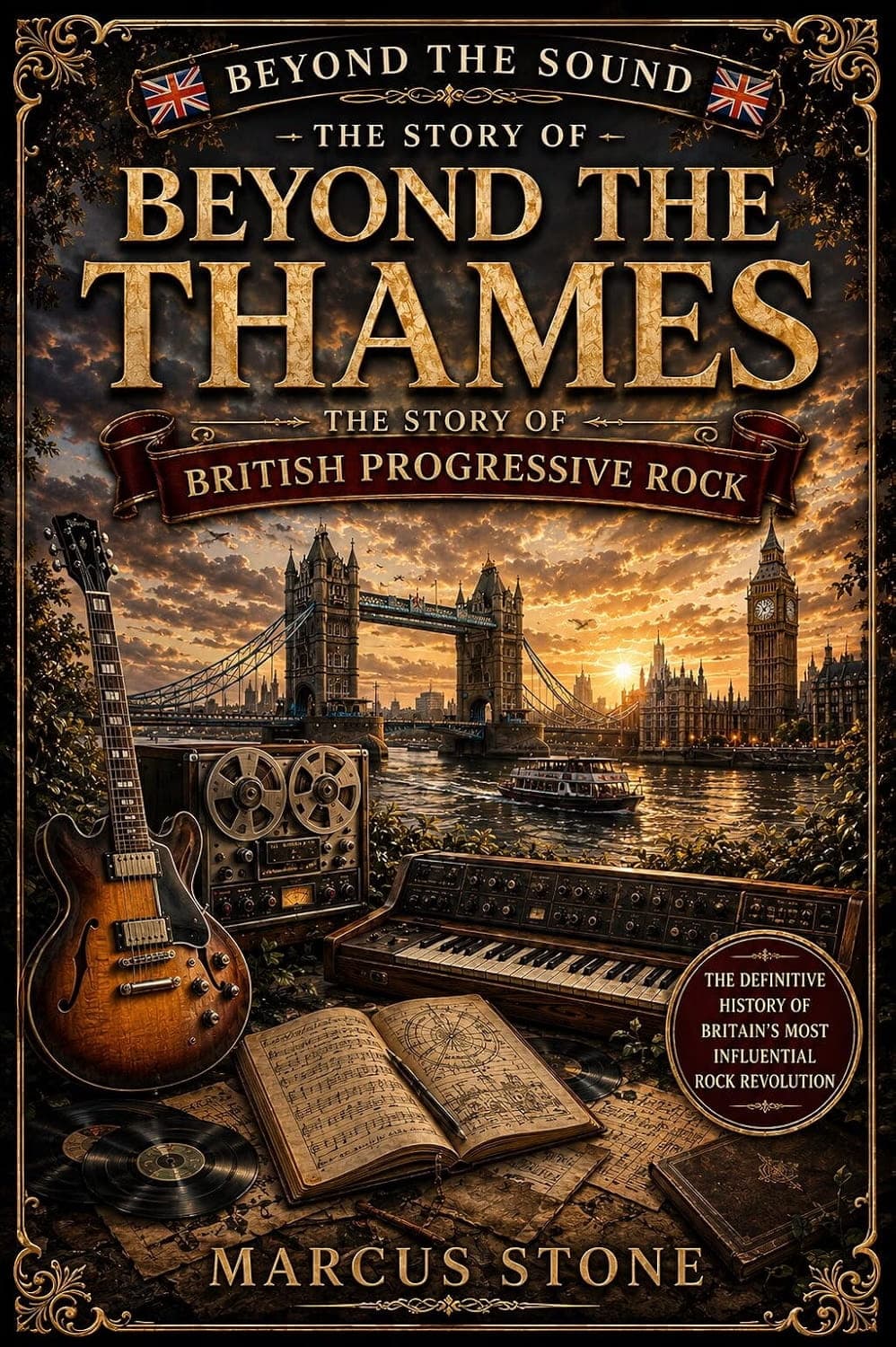
Beyond the Thames: The Story of British Progressive Rock
The book on British progressive rock — King Crimson, Yes, Genesis, Emerson, Lake & Palmer and the wider galaxy around them, from the art schools to the long afterlife.
- SeriesBeyond the Sound, 2 of 5
- AuthorMarcus Stone
- ChaptersFifteen, plus four appendices
In the years around 1970 a generation of British musicians turned songs into suites, took what they needed from classical music, jazz and folk, and started building album sides the way composers build movements. Beyond the Thames is the British progressive rock book that follows that story from its roots to the present day.
It is the second volume of Beyond the Sound, a five-part series that gives each national scene of progressive rock a book of its own. It stands entirely on its own: you do not need the other volumes to read it, and there is no required order.
What the book covers
Fifteen chapters across four parts, followed by a curated listening guide.
The Roots. Britain’s musical DNA: the art schools, the blues borrowed and reborn, the British Invasion turning inward, radio and the nation, the grammar-school generation, Canterbury before it had a name, and the psychedelic threshold. Then the spark of 1967 to 1969 — Sgt. Pepper’s, The Moody Blues, Procol Harum, The Nice, the independent label revolution, and King Crimson at the gate.
The Golden Age. It opens on 1969 as a year zero, then gives a chapter each to King Crimson, Yes, Genesis and Emerson, Lake & Palmer. A long chapter on the wider galaxy follows the bands beyond them: Soft Machine, Caravan, Hatfield and the North and National Health from Canterbury, then Van der Graaf Generator, Gentle Giant, Henry Cow, Camel, Renaissance, Barclay James Harvest, Jethro Tull, Gryphon, and the three hardest cases to classify — Roxy Music, Mike Oldfield and Pink Floyd.
The Context. What made the British sound different — the keyboard empire and the guitar counter-voice, the Mellotron, literature and landscape — the ecosystem of labels, studios and the business of prog, and a chapter on art school, class and the English condition.
After the Golden Age. The fall of 1976 to 1980, then the resurrection: Marillion and the neo-prog wave, the festival circuit and the faithful, the reappraisal of the 1990s and 2000s, Steven Wilson, and the living legacy of British prog today.
The Essential Collection. A curated listening guide, described below.
The listening guide and the appendices
The final chapter names thirty-six records in three tiers: Start Here, six gateway albums; Go Deeper, eighteen essential albums; and For Explorers, twelve deep cuts. Newcomers can take it in order; listeners who already know the famous records can jump straight to the last tier.
Four appendices follow: a visual timeline of British progressive rock from 1967 to 1980, a glossary of musical terms, a note on sources, and a preview of the volumes that follow.
Free download
A QR code at the front of the book opens The Listening Companion: an essential starter playlist of twenty-four tracks in a listening order built for newcomers, and a collector’s checklist of the thirty-six albums to tick off as you go. It is free, and you do not need the book to open it.
The full contents
Fifteen chapters in five parts, ninety-eight sections and four appendices.
Part I — The Roots
- Chapter 1 — Before the Storm: Britain’s Musical DNA
- 1.1 The Art School Republic
- 1.2 Blues, Borrowed and Reborn
- 1.3 The British Invasion Looks Inward
- 1.4 The Wireless and the Nation
- 1.5 Class, Ambition, and the Grammar School Boy
- 1.6 Canterbury Before Canterbury
- 1.7 The Psychedelic Threshold
- Chapter 2 — The Spark: 1967–1969
- 2.1 Sgt. Pepper’s and the License to Experiment
- 2.2 The Moody Blues and the Orchestra in the Machine
- 2.3 Procol Harum and the Bach Connection
- 2.4 The Nice: Emerson’s First Detonation
- 2.5 The Independent Label Revolution
- 2.6 The Counterculture as Fuel
- 2.7 King Crimson at the Gate
Part II — The Golden Age
- Chapter 3 — 1969: The Year Zero
- 3.1 In the Court: The Album That Drew the Map
- 3.2 Hyde Park, July 5
- 3.3 Yes Assemble
- 3.4 Genesis at Charterhouse
- 3.5 The Simultaneous Bloom
- 3.6 What 1969 Made Possible
- Chapter 4 — King Crimson: The Architects
- 4.1 Fripp’s Discipline
- 4.2 In the Court of the Crimson King
- 4.3 The Revolving Door as Method
- 4.4 Larks’ Tongues and the European Turn
- 4.5 Red and the First Death
- 4.6 Discipline: The Reinvention
- 4.7 Why Crimson Mattered Most
- Chapter 5 — Yes: The Maximalists
- 5.1 The Quest for the Perfect Take
- 5.2 The Classic Lineup Crystallizes
- 5.3 The Yes Album and Fragile
- 5.4 Close to the Edge: The Summit
- 5.5 Tales from Topographic Oceans: The Reckoning
- 5.6 Relayer and the Fractures
- 5.7 Yes as the Public Face of Prog
- Chapter 6 — Genesis: The Storytellers
- 6.1 From Public School to Pop Songs
- 6.2 Trespass and Nursery Cryme
- 6.3 Foxtrot and the Theatre of Gabriel
- 6.4 Selling England by the Pound
- 6.5 The Lamb Lies Down on Broadway
- 6.6 Gabriel Departs, Collins Steps Up
- 6.7 The Long Pivot to the Stadium
- Chapter 7 — Emerson, Lake & Palmer: The Virtuosos
- 7.1 The Supergroup Gamble
- 7.2 Tarkus and the Armadillo Tank
- 7.3 Pictures at an Exhibition
- 7.4 Brain Salad Surgery and the Peak of Excess
- 7.5 The Excess Debate
- 7.6 Strengths and Vulnerabilities Embodied
- Chapter 8 — The Wider Galaxy
- 8.1 The Map Beyond the Big Five
- 8.2 Canterbury I: Soft Machine
- 8.3 Canterbury II: Caravan
- 8.4 Canterbury III: Hatfield and the North & National Health
- 8.5 Van der Graaf Generator: The Dark Wing
- 8.6 Gentle Giant: The Polymaths
- 8.7 Henry Cow and the Avant-Garde Edge
- 8.8 Camel: The Symphonic Satellites
- 8.9 Renaissance and Barclay James Harvest
- 8.10 Jethro Tull: Progressive Folk
- 8.11 Gryphon and the Early Music Detour
- 8.12 The Unclassifiable: Roxy Music, Mike Oldfield, and Pink Floyd’s Question
Part III — The Context
- Chapter 9 — The British Sound: What Made It Different
- 9.1 Art School vs. Conservatory
- 9.2 The Keyboard Empire and the Guitar Counter-Voice
- 9.3 Structure vs. Melody: The British Bias
- 9.4 The Mellotron and the English Fog
- 9.5 Literature, Landscape, and the Pastoral
- 9.6 The Sound Decoded
- Chapter 10 — The Ecosystem: Labels, Studios, and the Business of Prog
- 10.1 Charisma and the Gentleman’s Game
- 10.2 Island, Virgin, Vertigo, EG
- 10.3 The Producers
- 10.4 The Temples: Trident, Olympic, The Manor
- 10.5 The Economics of Excess
- 10.6 Art and Commerce in Tension
- Chapter 11 — Art School, Class War, and the English Condition
- 11.1 The Art School Pipeline
- 11.2 Middle-Class Ambition or Genuine Revolution?
- 11.3 The Canterbury/London Divide
- 11.4 Prog and the Counterculture’s Limits
- 11.5 The Englishness Problem
- 11.6 The Condition, Diagnosed
Part IV — After the Golden Age
- Chapter 12 — The Fall: 1976–1980
- 12.1 The Pistols and the Cultural Assault
- 12.2 How Prog Became the Enemy
- 12.3 The Speed of the Repudiation
- 12.4 Genesis Goes Pop
- 12.5 Yes Fragments, Crimson Dissolves
- 12.6 What the Fall Revealed
- Chapter 13 — Resurrection: Neo-Prog, Critical Reassessment, and Legacy
- 13.1 Marillion and the Neo-Prog Wave
- 13.2 The Festival Circuit and the Faithful
- 13.3 The 1990s–2000s Reappraisal
- 13.4 Steven Wilson, the Modern Champion
- 13.5 How the Reputation Recovered
- 13.6 The Long Vindication
- Chapter 14 — The Living Legacy
- 14.1 British Prog in the 21st Century
- 14.2 The Contemporary Scene
- 14.3 The Streaming Era and the Archive
- 14.4 Academic and Cultural Recognition
- 14.5 Why It Endures (and Why This Book Exists)
Final Section — The Essential Collection
- Chapter 15 — The Essential Collection: A Curated Listening Guide
- 15.1 Start Here: 6 Gateway Albums
- 15.2 Go Deeper: 18 Essential Albums
- 15.3 For Explorers: 12 Deep Cuts
- 15.4 How to Listen: Availability, Best Editions, Streaming
Appendices
- Appendix A — Visual Timeline: British Progressive Rock, 1967–1980
- Appendix B — Glossary of Musical Terms
- Appendix C — Note on Sources
- Appendix D — Series Preview: Volumes 3–5
Who it is for
Readers who know the famous British albums and want the scene around them — where the bands came from, who paid for the records, and why the whole thing fell so far and so fast after 1976. Listeners coming to the music now, through Steven Wilson or the modern bands, who want to know what they are hearing the echo of. And anyone who likes music history told as narrative.
View Beyond the Thames on Amazon →
The bands at the heart of the book
Each of the four bands with a chapter of their own has a full guide on this site, with every album in order.
The wider galaxy has its guides too — Pink Floyd, Van der Graaf Generator, Gentle Giant, Jethro Tull and Camel among them — and the Canterbury bands, from Soft Machine to Caravan, have a scene guide of their own. For every British band in the archive, start from the British progressive rock scene guide.
The rest of the series
Beyond the Sound follows progressive rock from scene to scene. Each volume stands on its own.
Or see the whole series together.