BookVolume 1
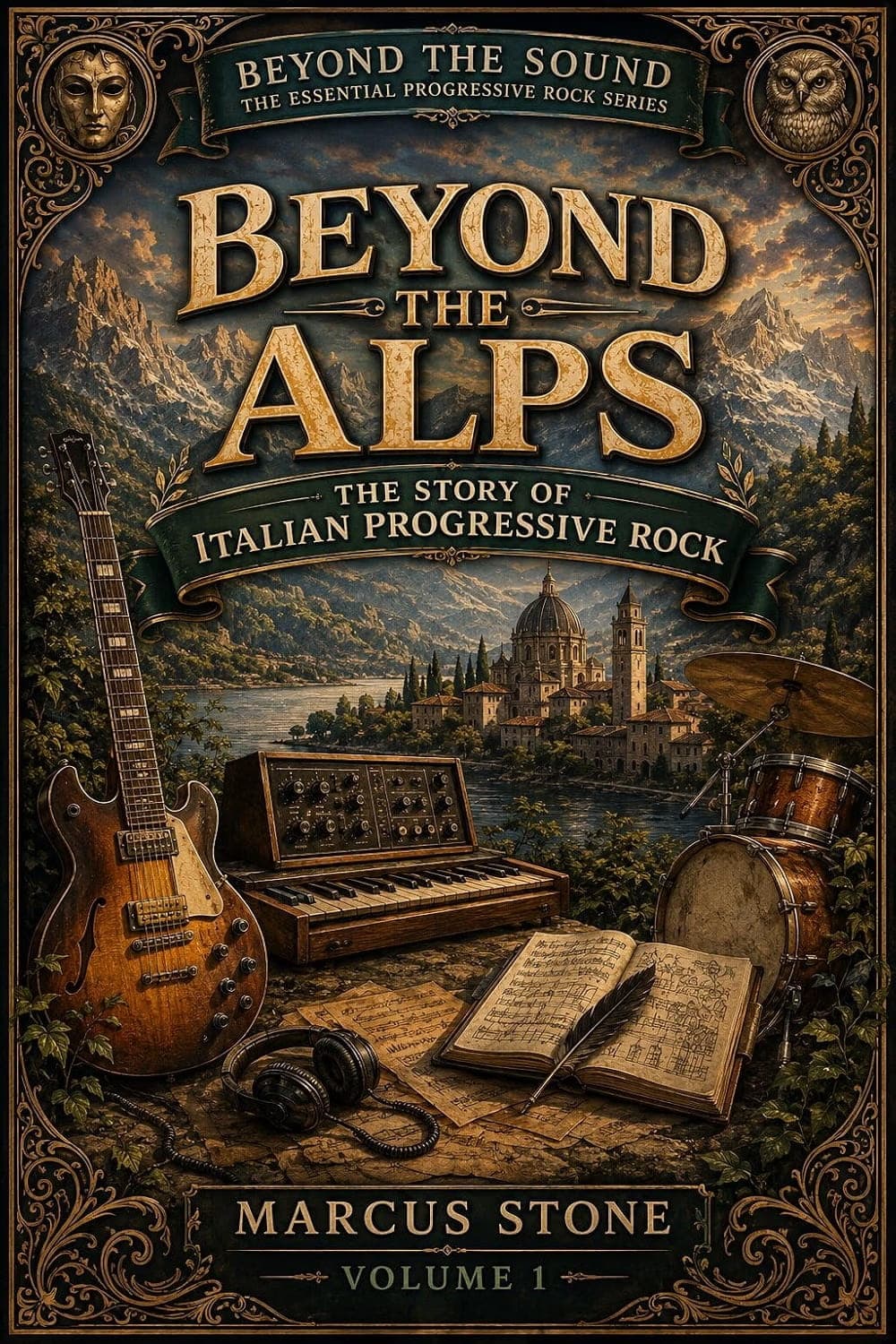
Beyond the Alps: The Story of Italian Progressive Rock
The book on Italian progressive rock — PFM, Banco, Le Orme, Area and the golden age of RPI, told in full and checked against primary sources.
- SeriesBeyond the Sound, 1 of 5
- AuthorMarcus Stone
- EditionSecond, revised and corrected
Between 1971 and 1976 a few dozen Italian bands made some of the most ambitious rock records ever released, sold them almost entirely at home, and were largely forgotten outside Italy for thirty years. Beyond the Alps is the Italian progressive rock book that tells that story in full, in English, from the records and the paperwork outward.
It is the first volume of Beyond the Sound, a five-part series that gives each national scene of progressive rock a book of its own. It stands entirely on its own: you do not need the other volumes to read it, and there is no required order.
What the book covers
Sixteen chapters across five parts, moving from the conditions that made the music possible, through the records themselves, to what happened after.
The Roots. Opera, the church organ and the conservatory system; then the beat years and the turn of 1963 to 1970. Including the most repeated explanation of Italian prog — that its musicians were conservatory-trained classical players — and why, checked name by name, it turns out not to be true.
The Golden Age. Eight chapters. It opens with a corrected chronology of what was actually released in 1971 and 1972, then gives a chapter each to Premiata Forneria Marconi, Banco del Mutuo Soccorso, Le Orme and Area, and three more to the wider galaxy: the symphonic wing, the regional scenes, and the jazz and avant-garde edges.
The Context. What made the Italian sound different, the ecosystem of labels, studios and festivals that paid for it, and the Years of Lead — including the claim that political violence ended Italian progressive rock, which the book finds to be half unmeasured and half wrong.
After the Golden Age. The fall of 1976 to 1980, then rediscovery and legacy: the Japanese collectors and the vinyl trade, the reissue era, and the Italian scene of today.
The Essential Collection. A curated listening guide, described below.
A corrected second edition
The first edition of this book contained six factual errors. A reader listed them in public, and this edition exists because of that list; Section 15.4 sets out what they were.
What changed is the method. Every date, line-up, credit and chart position in the second edition was checked against primary sources before it was written. Where the sources disagree, the book shows the disagreement instead of quietly choosing one version, and where nothing could be confirmed, the sentence was cut. Appendix D lists every source actually consulted.
The listening guide and the appendices
The final chapter names thirty-six records in three tiers: Start Here, six ways in; Go Deeper, eighteen essential albums; and For Explorers, twelve deep cuts. It is not a ranking and it gives no verdicts on how the records sound. For each one it gives the original Italian label and catalogue number, the year, where the book discusses it and what it did on the chart — so a buyer knows which object to look for.
Five appendices follow: a visual timeline from 1967 to 1982, a note on pronouncing the names, a glossary, a note on sources, and a preview of the rest of the series.
Free download
A QR code at the front of the book opens The Listening Companion: the thirty-six records as a list to work through in order, the pressing details that tell an original from a reissue, the full timeline from 1967 to 1982, and every source as a live link alongside the corrections found after printing. It is free, and you do not need the book to open it.
The full contents
Sixteen chapters in five parts, seventy-six sections and five appendices. The Introduction sets out the question the whole book answers: why Italy, and not France or anywhere else.
Introduction — Why Italy
Part I — The Roots
- Chapter 1 — The Inheritance: Opera, Church, Conservatory
- 1.1 The Opera Nation: What Italy Already Knew About Drama
- 1.2 The Conservatory System and the Trained Musician
- 1.3 Sacred Music, the Church, and the Organ
- 1.4 The Cantautori: Song as Literature
- 1.5 Geography: North, South, and the Regional Scenes
- Chapter 2 — The Beat Years and the Turn (1963–1970)
- 2.1 Italian Beat and the Imported Model
- 2.2 Sanremo, RAI, and the Machine
- 2.3 The First Cracks: Le Orme, New Trolls, I Quelli
- 2.4 1968 in Italy and the Political Temperature
- 2.5 The Foreign Catalyst: British Prog Arrives
Part II — The Golden Age
- Chapter 3 — The Explosion: What Happened When
- 3.1 The Corrected Timeline
- 3.2 Le Orme and the First Move
- 3.3 PFM Arrive
- 3.4 Banco Arrive
- 3.5 Why It Happened When It Did
- Chapter 4 — Premiata Forneria Marconi
- 4.1 From I Quelli to PFM
- 4.2 Storia di un Minuto
- 4.3 Per un Amico
- 4.4 Manticore, Photos of Ghosts and the English Gamble
- 4.5 L’Isola di Niente and the International Years
- 4.6 What the English Gamble Cost Them
- Chapter 5 — Banco del Mutuo Soccorso
- 5.1 The Nocenzi Brothers and the Roman Scene
- 5.2 The Debut
- 5.3 Darwin!
- 5.4 Io Sono Nato Libero
- 5.5 The Manticore Detour and the English Records
- 5.6 ...di terra and the Late Period
- Chapter 6 — Le Orme
- 6.1 From Beat to Prog
- 6.2 Collage
- 6.3 Uomo di pezza
- 6.4 Felona e Sorona
- 6.5 Contrappunti and After
- Chapter 7 — Area
- 7.1 Demetrio Stratos and the Voice
- 7.2 Arbeit macht frei
- 7.3 The Political Position
- 7.4 Crac! and the Jazz Turn
- Chapter 8 — The Wider Galaxy I: The Symphonic Wing
- 8.1 New Trolls and Concerto Grosso
- 8.2 Museo Rosenbach
- 8.3 Il Balletto di Bronzo
- 8.4 Alphataurus
- 8.5 Locanda delle Fate
- 8.6 Latte e Miele and the Sacred Strand
- Chapter 9 — The Wider Galaxy II: The Regional Scenes
- 9.1 Osanna and Naples
- 9.2 Il Rovescio della Medaglia
- 9.3 Quella Vecchia Locanda
- 9.4 Semiramis, Biglietto per l’Inferno and the One-Album Bands
- 9.5 The Trip and the Proto-Prog Question
- Chapter 10 — The Wider Galaxy III: Jazz, Avant-garde and the Edges
- 10.1 Perigeo and the Jazz-Rock Wing
- 10.2 Arti e Mestieri
- 10.3 Picchio dal Pozzo, Stormy Six and the Avant-Garde Edge
- 10.4 Goblin and the Soundtrack Strand
Part III — The Context
- Chapter 11 — The Italian Sound: What Made It Different
- 11.1 Opera Inside the Rock Band
- 11.2 The Voice as Instrument
- 11.3 Melody Against Structure: The Italian Bias
- 11.4 Why They Sang in Italian
- 11.5 The Sound Decoded
- Chapter 12 — The Ecosystem: Labels, Studios, Festivals
- 12.1 Numero Uno, Fonit Cetra, Ricordi and the Others
- 12.2 The Studios and the Producers
- 12.3 The Festivals and the Live Circuit
- 12.4 The Economics of a Domestic Market
- Chapter 13 — The Years of Lead
- 13.1 Autoriduzione: The Campaign Against the Ticket
- 13.2 Music and the Movement
- 13.3 When the Audience Turned
- 13.4 What the Violence Cost the Music
Part IV — After the Golden Age
- Chapter 14 — The Fall (1976–1980)
- 14.1 Disco, Punk and the Change of Weather
- 14.2 The Bands Break Up
- 14.3 The Industry Withdraws
- 14.4 What Actually Killed It
- Chapter 15 — Rediscovery and Legacy
- 15.1 The Japanese Collectors and the Vinyl Trade
- 15.2 The Reissue Era and the Internet
- 15.3 The Modern Italian Scene
- 15.4 Why It Endures (and Why This Book Exists)
Final Section — The Essential Collection
- Chapter 16 — A Curated Listening Guide
- 16.1 Start Here: Six Ways In
- 16.2 Go Deeper: Eighteen Essential Albums
- 16.3 For Explorers: Twelve Deep Cuts
- 16.4 How to Listen: What Can Be Documented, and What Cannot
Appendices
- Appendix A — Visual Timeline: Italian Progressive Rock, 1967–1982
- Appendix B — A Note on Pronouncing the Names
- Appendix C — Glossary of Terms Used in This Book
- Appendix D — A Note on Sources
- Appendix E — The Rest of the Series
Who it is for
Readers who know British prog well and have only scratched the Italian surface. Listeners who found one of these records by accident — in a second-hand bin, in someone else’s collection — and want to understand the world it came from. And anyone who likes music history told as narrative, with the evidence shown.
View Beyond the Alps on Amazon →
The bands at the heart of the book
Each of the four bands with a chapter of their own has a full guide on this site, with every album in order.
For every other Italian band in the archive, from Osanna and New Trolls to Museo Rosenbach and Goblin, start from the Italian progressive rock scene guide.
The rest of the series
Beyond the Sound follows progressive rock from scene to scene. Each volume stands on its own.
Or see the whole series together.