
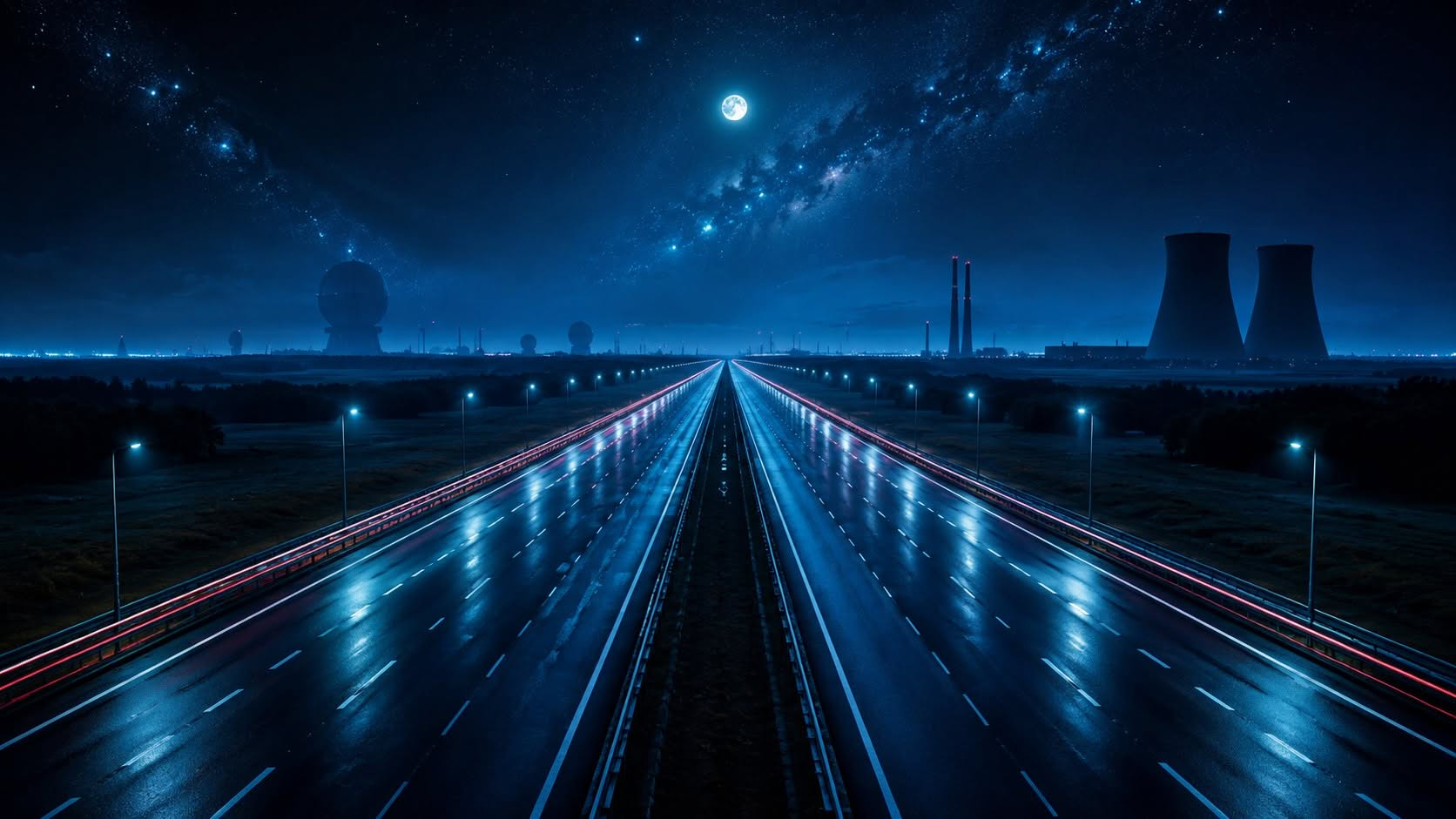
AlbumGerman
Mirage
- BandKlaus Schulze
- Released1977
- StyleGerman progressive rock
- Line-upKlaus Schulze
An electronic winter landscape — Klaus Schulze’s frozen masterpiece. Mirage is widely regarded as one of Klaus Schulze’s greatest albums: a vast, icy, deeply immersive work he himself subtitled an electronic winter landscape. Released in 1977, it steps away from the driving sequencers of Moondawn and Body Love into something more subdued, tranquil and profoundly moody — two side-long compositions built from slowly shifting layers of synthesizer. Cold, meditative and quietly overwhelming.
The short version
Klaus Schulze’s eighth album, recorded in Frankfurt in January 1977 and released that April on the Brain label; two side-long compositions, each moving through several titled sections. Schulze plays everything, weaving layer upon layer of synthesizer into a subtitled “electronic winter landscape.” A landmark of ambient and Berlin School music, it turns away from the propulsive rhythms of his previous few albums toward something quieter, colder and more meditative. Widely considered one of his finest works, it is a deeply immersive, icy soundscape that rewards patient, focused listening more than almost any other record in his catalogue.
An electronic winter landscape
By 1977 Klaus Schulze was among the central figures of German electronic music, and Mirage was his eighth album in only five years. It arrived as a deliberate change of direction. Where Timewind, Moondawn and Body Love had ridden pulsing, propulsive sequencers, Mirage set almost all of that aside in favour of stillness, subtitling itself “an electronic winter landscape” and evoking vast, frozen, solitary spaces. The album is dedicated to Schulze’s brother, Hans Dieter Schulze, and was shaped by a deeply personal time in the composer’s life, and something of that feeling seems to settle over the whole record, lending its icy beauty a real emotional weight. The two long pieces are each divided into several titled sections, described by Schulze as lyrical paths through the continuous music, though they play without a break.
The sound
Subdued, tranquil, deeply immersive electronic music, an icy soundscape of slowly shifting synthesizer layers. Where much of Schulze’s mid-seventies work drove forward on insistent sequences, Mirage mostly floats, its overlapping synth strata and echoing pads conjuring a cold, spacious, desert-like solitude. It is minimalism as atmosphere: sequences do surface, and a gentle electronic pulse gradually emerges from the somber waves of sound, but the overall effect is of vast, frozen stillness rather than momentum. The music has a genuinely three-dimensional quality, best experienced when it is allowed to envelop the listener completely, and it moves through moments of glassy beauty, siren-like synth lines and shimmering, crystalline textures. Cold, celestial and quietly overwhelming, it is Schulze at his most meditative and atmospheric.
Reading up on Krautrock? The books go deeper →
The songs
The album is built from two side-long compositions, each flowing through several named sections. Velvet Voyage opens in icy, abstract calm, its overlapping synthesizers recalling the spacier reaches of Pink Floyd before a slow, organic pulse gathers beneath the somber waves; many hold it to be the album’s masterpiece. Crystal Lake begins with the lively, chiming Xylotones, a motif that has drawn comparison to Mike Oldfield’s Tubular Bells, then builds through glassy, siren-laced sequences before dissolving, around its midpoint, into textures that echo the first piece and link the two into a single circular whole. Its closing minutes are among the most celebrated in all of instrumental electronic music. Later reissues add a further long bonus piece.
Reception and legacy
Mirage is widely hailed as one of Klaus Schulze’s masterpieces and a milestone of ambient and electronic music. Admirers single out the sublime beauty of both pieces, the icy, immersive atmosphere and the extraordinary final stretch of Crystal Lake, often named among the finest passages in the whole electronic genre. It is a more subdued and demanding record than his rhythmic albums, and some listeners find it less immediately engaging, yet it sold well and its reputation has only grown with time. Meditative, cold and profoundly atmospheric, it stands alongside Moondawn as many people’s favourite Schulze album. For anyone drawn to deep, immersive electronic music, it is essential listening and one of the high points of the Berlin School.
The verdict
Essential Klaus Schulze, and one of the peaks of ambient and Berlin School music — a cold, immersive electronic winter landscape of rare beauty and depth. Come to it for the icy atmosphere, the slowly unfolding synthesizer layers and the sublime finale of Crystal Lake, rather than for the driving sequencers of his more rhythmic work. Best heard whole, in stillness, with full attention. Then Moondawn and Body Love for his propulsive side, Cyborg for his early tape-era isolation, and Mike Oldfield and Tangerine Dream for kindred spirits. A frozen masterpiece — and one of the most beautiful albums in electronic music.