BookVolume 3
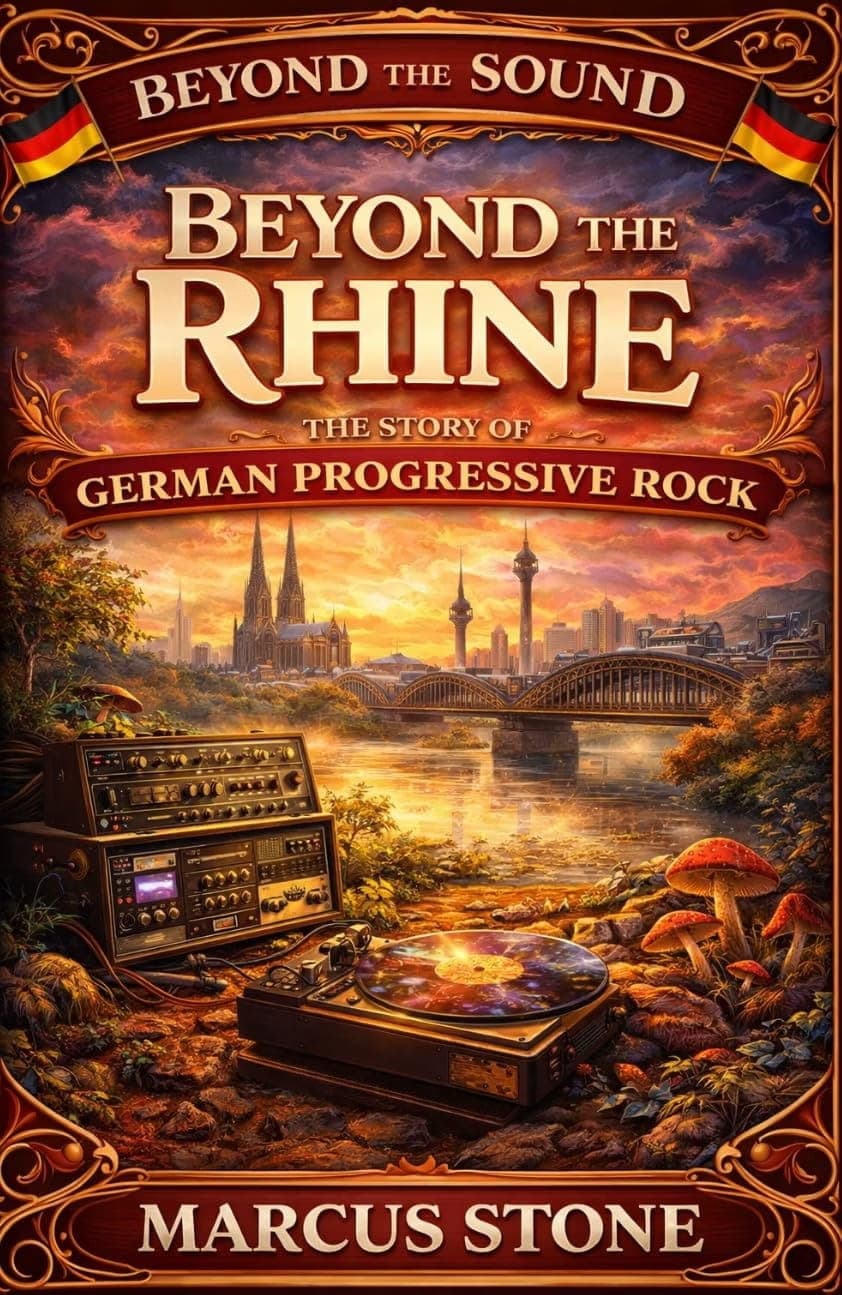
Beyond the Rhine: The Story of German Progressive Rock
The book on Krautrock and German progressive rock — Can, Neu!, Kraftwerk, Tangerine Dream, Faust and the cosmic sound, from the studios where it was built to the music it went on to shape.
- SeriesBeyond the Sound, 3 of 5
- AuthorMarcus Stone
- ChaptersTwenty-one, plus five appendices
In the years after 1968 a generation of West German musicians refused two things at once — the Anglo-American blues-rock everyone else was copying, and the German Schlager they had grown up with — and built something with no obvious ancestors. Beyond the Rhine is the book on Krautrock and German progressive rock: where that music came from, who made it, how it was assembled in the studio, and what it turned into after the 1970s.
It is the third volume of Beyond the Sound, a five-part series that gives each national scene of progressive rock a book of its own. It stands entirely on its own: you do not need the other volumes to read it, and there is no required order.
What the book covers
Twenty-one chapters across four parts, followed by a curated listening guide.
The Roots. West Germany after 1968 and the generation that came of age there, the double refusal of blues-rock and Schlager, and the word Krautrock itself — where it came from and the baggage it carried. Then a chapter on how the sound was built: Conny Plank and the producer as author, the studios and the communes, electronics entering rock, and the festivals of the live underground. The part closes with Can, in the chapter the book calls The Method.
The Golden Age. A chapter each to Neu! and the motorik pulse, Faust, Tangerine Dream and the cosmic turn, Klaus Schulze, Ash Ra Tempel and the Cosmic Couriers, Amon Düül II, Cluster and Harmonia on the Düsseldorf–Forst axis, Popol Vuh, and Kraftwerk as the bridge. Then the symphonic and melodic branch — Eloy, Grobschnitt, Novalis and Jane — and a wider galaxy that takes in Guru Guru, Kraan, Embryo, Triumvirat, Lucifer’s Friend, Wallenstein, Birth Control and Nektar.
The Context. What made the German sound different, the politics and the philosophy behind it, and the ecosystem of labels, studios and the scene around them.
After the Golden Age. The fade and the transformation — the end of the communes, disco and the Berlin School — then the enormous afterlife: post-punk and the British rediscovery, ambient and the Eno connection, techno and the motorik inheritance in Detroit, and the modern reassessment. The last chapter is the living legacy.
The Essential Collection. A curated listening guide, described below.
How the book was built
The book says it plainly: everything in it that is presented as a fact was checked against sources before it was written — release dates, line-ups, who played what, where a record was made, which machines existed and when. Appendix D lists the sources actually consulted.
The same discipline decides what stays out. The famous remark attributed to Brian Eno, calling Harmonia the most important band in the world, is treated as what it is: repeated everywhere, and never traced to an interview anyone can produce.
The listening guide and the appendices
The final chapter names thirty-six records in three tiers: Start Here, six gateway albums; Go Deeper, eighteen essential albums; and For Explorers, twelve deep cuts. Newcomers can take it in order; listeners who already know the famous records can go straight to the last tier.
Five appendices follow: a visual timeline of German progressive rock from 1968 to 1978, a pronunciation guide, a glossary of musical and historical terms, a note on sources, and a preview of the rest of the series.
Free download
A QR code at the front of the book opens The Listening Companion: a guided listening path through the records in the order that makes sense, six things worth knowing before you press play, the questions the sources leave genuinely open, and every source consulted as a clickable link. It is free, and you do not need the book to open it.
The full contents
Twenty-one chapters in four parts and a final section, seventy-eight sections and five appendices.
Introduction — Why Germany
Part I — The Roots
- Chapter 1 — Out of the Rubble: The Making of a German Underground
- 1.1 The Fatherless Generation: West Germany After 1968
- 1.2 The Double Refusal: Against Blues-Rock, Against Schlager
- 1.3 Laboratories of Sound: Studios, Engineers and Machines
- 1.4 The Word Itself: Unpicking "Krautrock"
- Chapter 2 — The Workshops and the Wire: How the Sound Was Built
- 2.1 Conny Plank and the Producer as Author
- 2.2 The Studios and the Communes as Laboratories
- 2.3 Electronics Enters Rock
- 2.4 The Festivals and the Live Underground
- 2.5 "Krautrock": The Name and Its Baggage
- Chapter 3 — Can: The Method
- 3.1 The Art-School Origins and the Two Singers
- 3.2 Monster Movie and the Birth of the Sound
- 3.3 Tago Mago: The Peak
- 3.4 Ege Bamyasi and Future Days
- 3.5 Editing as Composition
- 3.6 Why Can Mattered Most
Part II — The Golden Age
- Chapter 4 — Neu! and the Motorik Pulse
- 4.1 Rother and Dinger: The Split from Kraftwerk
- 4.2 The Motorik Beat Explained
- 4.3 Neu!, Neu! 2, and the Halved Album
- 4.4 Neu! 75 and the Two Sides
- 4.5 The Rhythm That Conquered the World
- Chapter 5 — Faust: The Anarchists
- 5.1 The Wümme Commune and the Polydor Gamble
- 5.2 The Faust Tapes and the Collage Method
- 5.3 Faust IV and the End of the Experiment
- 5.4 Faust as Provocation
- Chapter 6 — Tangerine Dream and the Cosmic Turn
- 6.1 Froese and the Berlin School
- 6.2 From Electronic Meditation to Zeit
- 6.3 Phaedra and the Sequencer Revolution
- 6.4 The Soundtrack Years and the Global Reach
- Chapter 7 — Klaus Schulze and the Electronic Landscape
- 7.1 From Drummer to Solo Voyager
- 7.2 Irrlicht, Cyborg, and the Long Form
- 7.3 Moondawn and the Mature Style
- Chapter 8 — The Kosmische Wing: Ash Ra Tempel and the Cosmic Couriers
- 8.1 Manuel Göttsching and Ash Ra Tempel
- 8.2 The Cosmic Jokers and the Kaiser Circle
- 8.3 E2-E4 and the Bridge to the Future
- Chapter 9 — Amon Düül II: The Collective
- 9.1 From Political Commune to Two Bands
- 9.2 Phallus Dei and Yeti
- 9.3 Tanz der Lemminge and the Psychedelic Peak
- Chapter 10 — The Düsseldorf–Forst Axis: Cluster and Harmonia
- 10.1 Kluster to Cluster
- 10.2 Harmonia: The Supergroup That Wasn’t Famous
- 10.3 Eno Comes to Forst
- Chapter 11 — Popol Vuh: The Mystics
- 11.1 Fricke and the Moog Abandoned
- 11.2 The Herzog Soundtracks
- 11.3 The Spiritual Turn
- Chapter 12 — Kraftwerk: The Bridge
- 12.1 The Düsseldorf Roots and the Kraftwerk/Neu! Split
- 12.2 The Early Experimental Albums
- 12.3 Autobahn and the Break with Krautrock
- 12.4 Why They Belong Here — and Point to Volume 5
- Chapter 13 — The Symphonic and Melodic Branch
- 13.1 Eloy: Germany’s Space-Rock Giants
- 13.2 Grobschnitt: Theatre and the Side-Long Suite
- 13.3 Novalis, Jane, and the Melodic School
- Chapter 14 — The Wider Galaxy
- 14.1 The Map Beyond the Core
- 14.2 Guru Guru and the Free-Rock Wing
- 14.3 Kraan and the Jazz-Inflected Groove
- 14.4 Embryo and the World-Music Restlessness
- 14.5 Triumvirat, Lucifer’s Friend, Wallenstein
- 14.6 Birth Control, Nektar, and the Anglo-German Border
Part III — The Context
- Chapter 15 — The German Sound: What Made It Different
- 15.1 Repetition and the Motorik Principle
- 15.2 The Rejection of the Blues
- 15.3 Electronics as Identity, Not Gimmick
- 15.4 The Sound Decoded
- Chapter 16 — The Politics and the Philosophy
- 16.1 Music as Identity in a Divided Nation
- 16.2 The Weight of the Past and the Year-Zero Impulse
- 16.3 The Commune as Political Statement
- Chapter 17 — The Ecosystem: Labels, Studios, the Scene
- 17.1 Ohr, Brain, and the Independent Labels
- 17.2 The Kaiser Empire and Its Collapse
- 17.3 Radio, the Press, and How the Music Spread
Part IV — After the Golden Age
- Chapter 18 — The Fade and the Transformation
- 18.1 The End of the Communes
- 18.2 Disco, the Berlin School, and the Electronic Drift
- Chapter 19 — The Enormous Afterlife
- 19.1 Post-Punk and the British Rediscovery
- 19.2 Ambient and the Eno Connection
- 19.3 Techno, Detroit, and the Motorik DNA
- 19.4 The Modern Reassessment
- Chapter 20 — The Living Legacy
- 20.1 Krautrock in the 21st Century
- 20.2 Why It Endures (and Why This Book Exists)
Final Section — The Essential Collection
- Chapter 21 — The Essential Collection: A Curated Listening Guide
- 21.1 Start Here: Six Gateway Albums
- 21.2 Go Deeper: Eighteen Essential Albums
- 21.3 For Explorers: Twelve Deep Cuts
- 21.4 How to Listen: Availability, Editions, Streaming
Appendices
- Appendix A — Visual Timeline: German Progressive Rock, 1968–1978
- Appendix B — Pronunciation Guide
- Appendix C — Glossary of Musical and Historical Terms
- Appendix D — A Note on Sources
- Appendix E — Series Preview: Beyond the Sound
Who it is for
Listeners who reached this music through what came after it — post-punk, ambient, techno — and want to know where the motorik beat and the sequencer drone came from. Readers who know the famous names and want the scene around them. And anyone who likes music history told as narrative.
View Beyond the Rhine on Amazon →
The bands at the heart of the book
Every band with a chapter of its own has a full guide on this site, with every album in order.
The symphonic branch and the wider galaxy have their guides too — Eloy, Grobschnitt and Guru Guru among them. For every German band in the archive, start from the Krautrock and German progressive rock scene guide.
The rest of the series
Beyond the Sound follows progressive rock from scene to scene. Each volume stands on its own.
Or see the whole series together.